a rebrand of sorts, but the same chaos at the heart of it…
a new domain, a slightly different theme, running with the analogy a little too much in the title… this newsletter has seen it all and then some. it started as a little side hustle for my mind, a way to think out loud with the world in a post-twitter era (back in my day it wasn’t a dumpster fire). someone once asked me why i publish these instead of just writing them in a journal, and i’ve never had a good answer to that question.
part of me does it to normalise the messiness of it all, to know that people with phds in stuff are just as much of a mess as everyone else (even more so sometimes), and that’s perfectly fine. i can know so much about the things i love and capture my curiosity that i am certain about none of it – and that’s my happy place. the most i can do is keep noticing, keep paying attention, and this little blog serves as a way of sharing what is capturing my attention in the hopes that something captures yours. with so much of this world fighting for a few seconds of your time, i know it is a privilege that people spend any of theirs reading this. at the same time, i definitely do not take it personally if these posts go unread.
it all started with The Reading List. i have often been referred to as the translator of academic work, where my explanations are sometimes easier to follow than the ideas that inspire them but i’ve always been torn about this nickname. this has sparked many conversations with friends in the academic world about who do we write for, what do we miss if we soften the theories that tether our work, and how palatable should we really make things? after all, the learning is in the work to grasp things, the pursuit of what that word means, where it comes from, why it matters. the joyful, nebulous journey of a reference list wormhole, falling from one paper to the next until you suddenly have 30 tabs open and cannot remember where you started from or why. having a dictionary open and making your own glossaries to explain key concepts back to yourself is the work. if you outsource this, reading only automatic summaries that group words together but miss the meaning between them that only you can bring, that is just hoarding – not learning.
i started The Reading List to do just that, keep reading. hundreds and hundreds of journal articles saved in a folder, begging to be read. i just keep piling more into that virtual space instead of making sense of the things i’ve already gathered. a graveyard of pdfs with a world of knowledge and nowhere to put it. there are so many incredible pieces of work in the world that i will never know, but i wanted to make the ones that i had found easier for others to (re)discover too. writing summaries in my own words, with my own stories and everyday experiences helped to ground this work, make it feel more tangible – to show the practicalities of a good theory. i still reference those early newsletters on key topics like representative learning design, chaos, uncertainty, knowledge, and talent pathways to this day, opening doors to ways of thinking and being differently.
then i shifted away from centering specific content, weaving concepts through my storytelling rather than foregrounding what we will talk about and why. there was safety in hiding behind those works in a way, constraining myself to the things they spoke about and how to ‘translate’ them. eventually i stopped needing a reason to hide. these concepts and stories were every bit a part of my daily existence, and sometimes the work can feel so far away from our everyday realities that we forget this is what inspired it all in the first place. as someone who is deeply inspired by and curious about anything to do with moving our bodies and learning, i feel and see and hear and think about topics like training design, instruction and feedback, perception and action, pedagogy and power constantly. i’ve always written from the heart, a stream of consciousness in a way. when i write, i open a blank page and just start typing – sometimes expanding on notes i’ve captured earlier, or just following whatever i’m pondering at the time. as some readers have often remarked, i want it to feel like i am speaking directly to you.
so the newsletter became known as The Thought Garden, which was a reflection of my thinking around personal knowledge management and the cultivation of ideas at the time. thinking through my experiences post-phd and full-time work, the harsh realities of community sport and trying to publish academic work that was a little outside the norm, and a gradual blending of poetry, music, and art. you can pretty much track my human development alongside the trajectory of my writing and that is intentional, my way of thinking writing being doing is every-evolving and the words i write are a reflection of that process of in-becoming.
wait, so where does the new name come from then? who needs three iterations of a damn newsletter?!
well, mostly i’m doing this because i can 😈 but also i wanted to move away from the box that is skill acquisition and talent development and research stuff because the world is so so much bigger and i am far more complex than the keywords at the end of my abstracts.
the name stems from a passing joke at the 2025 Australasian Skill Acquisition Network (ASAN) conference, where i presented my work and was accused of playing 4D Chess. as we sat in the corner booth of a bar, a simple question emerged: what would be your superhero/researcher name? if you had one name that had to represent both the kind of superhero you would be and the work that you do, what would you be called?
We had some outstanding recommendations based on puns, integrating versions of people’s names, and turning fields or theories into silly synonyms. i loved mine so much that i made it my whole personality – the butterfly affect.
i’ll explain the butterfly effect first, so you hopefully giggle at the punny change i’ve made later… (please laugh)
briefly, the butterfly effect is an “idea in chaos theory that describes how small changes to a complex system’s initial conditions can produce dramatically different outcomes.” (when in doubt, check the dictionary). now, it’s worth noting that the full name of chaos theory is deterministic chaos, which relates to unpredictable behaviour in deterministic systems. for any math/science nerds out there, you’ll note that these two words feel kinda paradoxical when put together, given a deterministic system is one where “no randomness is involved in the future states of the system” – what you put in is what you get out (in a way: you get the same output each time from an initial state or starting condition). we should be able to predict the future then, right!?
welp, that’s where the butterfly effect comes in. a meteorologist (Edward Lorenz) was looking to simulate various weather patterns with a computer model and repeated a simulation with a rounded value (from 0.506127 to 0.506). this seemingly small change created an entirely different weather simulation, which resembled butterfly wings.
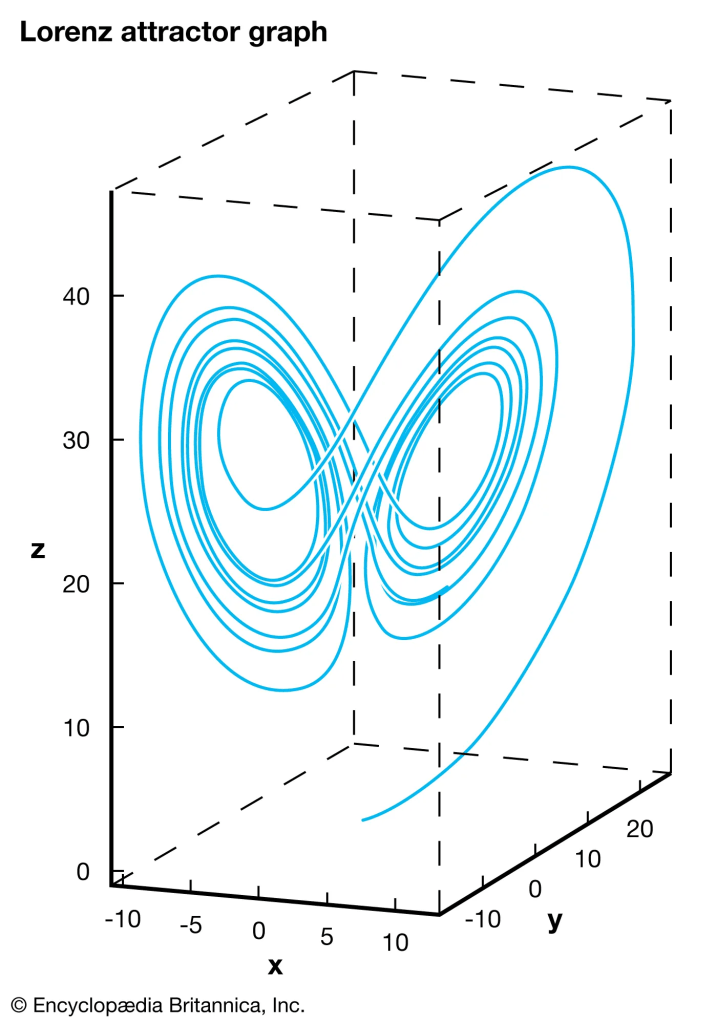
Lorenz (inspired by Philip Merilees) later titled a talk “Predictability: Does the Flap of a Butterfly’s Wings in Brazil Set Off a Tornado in Texas?”- a level of elite title craft that i aspire to! the ‘flap’ of the butterfly’s wings represents the tiny change of initial conditions that can lead to bigger/smaller/no outcomes. i love how much this challenged the ideas that even ‘simple’ systems can behave unpredictably, and when we bring that back to the complex, dynamic worlds we live in with complex, dynamic bodies to explore them, the predictability gets even lower.
this resonates with me on (at least) two levels – the first, that it challenged the fundamental notion by the likes of Isaac Newton that “science can accurately predict future outcomes.” if these predictions can be undone by the smallest of changes, like rounding up thousandths behind a decimal, then how much weight can we ever really put into these predictions, let alone trust our measurements of the initial conditions in the first place!?
the second – it’s close(r) to the nonlinear dynamics world that i am captivated by. in particular, the notion that a small change in the system may not have a proportionate change in the outcome – something, or nothing, could happen! this relates to non-proportionality: if i move a marker or cone, or take them away (!), all hell could break loose or nothing at all might change. any youth sport coaches out there also know that cones have a special kind of gravity well that sucks people in, so don’t expect people to not stand next to them the moment you put them down – and watch them follow that cone if you do move it (or not, who knows)!

these ideas are crucial to the way i see think feel act coach, regardless of the level i’m interacting with. from a ten-year-old staring me dead in the eyes while eating paper to the paralympian i may chat with on the sidelines, these principles are hidden below the surface of what i say do believe.
for the second half of this punny little name, i leveraged a lighthearted accusation by a friend recently: “you feel a lot, don’t you?” yes, i am renowned for hearing the things that are said in a whisper, seeing things that often go unnoticed and feel very deeply. it is an incredibly rich existence but the hypersensitivity is equally exhausting, like a tuning fork that endlessly rings and never comes to rest. the sneaky change from “effect” to “affect” doesn’t come from the endless verb/noun confusion of which one to use in a sentence but rather the post-humanist reading of the word that i am yet to (and may never) fully grasp – and that’s kinda the point.
as i search for ways of doing and being (in science and beyond) that are closer to my experiences of the world, i am drawn to the endless complexities of posthumanism as this fascinating unfolding of what it means to be human and more. a version where humans are not the privileged as “a distinctive, unique and dominant form of life” but rather just a part of it all. i’ll continue this story someday, it warrants its own space.
i’ll leave you with some threads to cast out with in the meantime:
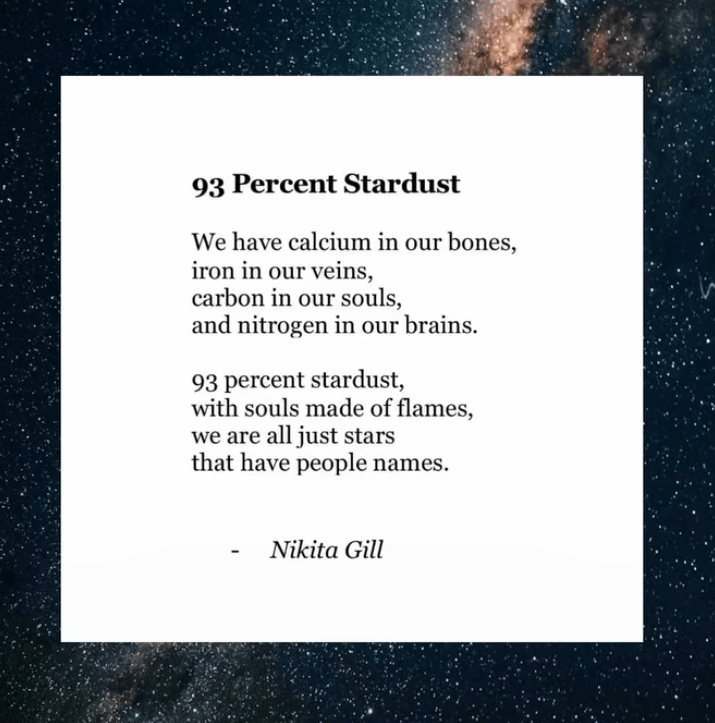
- a poem that i have no doubt used before – 93 Percent Stardust by Nikita Gill
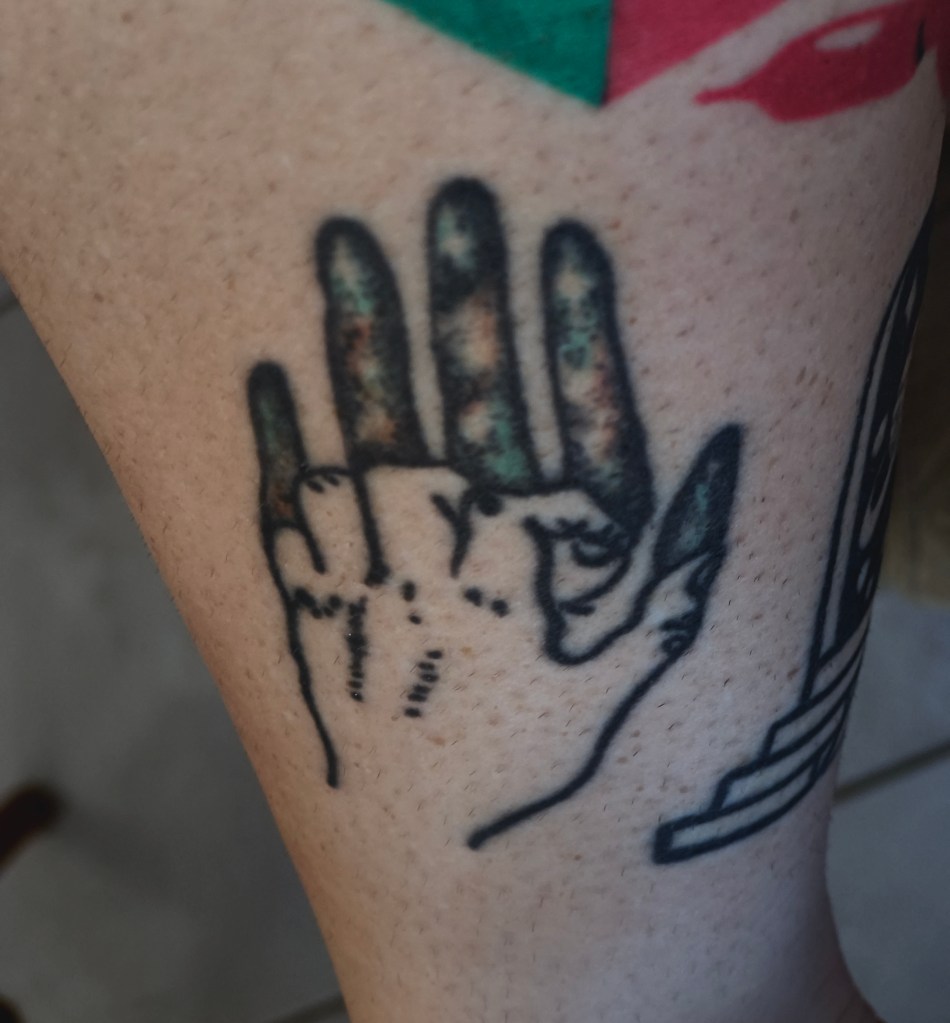
- the tattoo on my right leg that i dedicated to this poem in my 20s
- a song that reminds me of these – Cosmos by Zinadelphia
 butterfly affect
Leave a comment