A recap of the Australasian Skill Acquisition Network Conference, I guess.
Conference season has to be one of my favourite times of the year. I hold the same approximate week at the end of November open each year because I know that’s when we usually hold the Australasian Skill Acquisition Network Conference. I’ve no doubt mentioned this before, but just in case I haven’t, this conference lowkey saved my life as a PhD student. Venturing into a space like skill acquisition is kinda like a space walk to begin with: an unlikely cosmic event where the stars align and your love of sport collides with someone from the field, and then you notice all the constellations that have been there all along but you didn’t have a telescope yet, and now you’re in the thick of it, drowning in research papers with authors that will later become your friends. It’s a wild, messy, bumpy ride but for a long time I didn’t have anyone who truly understood what that untethered navigation felt like. The combined isolation of doing a PhD which creates a curious trauma bond, and a university landscape that didn’t really have anyone else in this same niche, really hit me. ‘Networking’ became a lifeline, and then very quickly stopped being networking. Conferences became opportunities to flex my skill acquisition muscles, to ponder loudly and uncertainly about the things I was most curious about, struggling to grasp, and confidently spouting when there was very little reason to be confident haha!
I distinctly remember the first year I attended at Moore Park in Sydney, 2018. I was about 9 months into my PhD, still enamoured by the unlikelihood that I was on this path, and just soaking it all up. I’d really taken to learning about presentation styles and science communication, I took every workshop that the researcher development office offered, and I entered in the mini 3-minute-thesis competition with nothing to present on but the hopeful direction of my PhD. Now, I’m acutely aware that not everyone does, or even gets the chance to do, their PhD on a topic that they are wholeheartedly enthusiastic about so the privilege to follow my curiosity was not lost on me then, and it certainly isn’t now. You are only allowed one slide to describe your whole thesis (!?), so I went with a Dumbledore quote, of course. What better way to introduce the topic of talent development to a skill acquisition conference than with this line:
“It is our choices, Harry, that show what we truly are, far more than our abilities.”
I remember walking away feeling welcomed, challenged, fascinated, and full of energy to continue on my journey. I’m pretty sure I even opened my confirmation document on the bus home and found new motivation to complete it, fuelled by the want to come back and have something to present about rather than just my hopes and dreams. When people ask me if and why they should go, I often describe ASAN as the perfect place for a PhD student, especially to present for the first time. As a tight-knit community (mostly) in the southern hemisphere, who are often on the outside of global movements and events due to time zones and distance and travel costs, this group helps sustain the growth and development of those fascinated by growth and development.
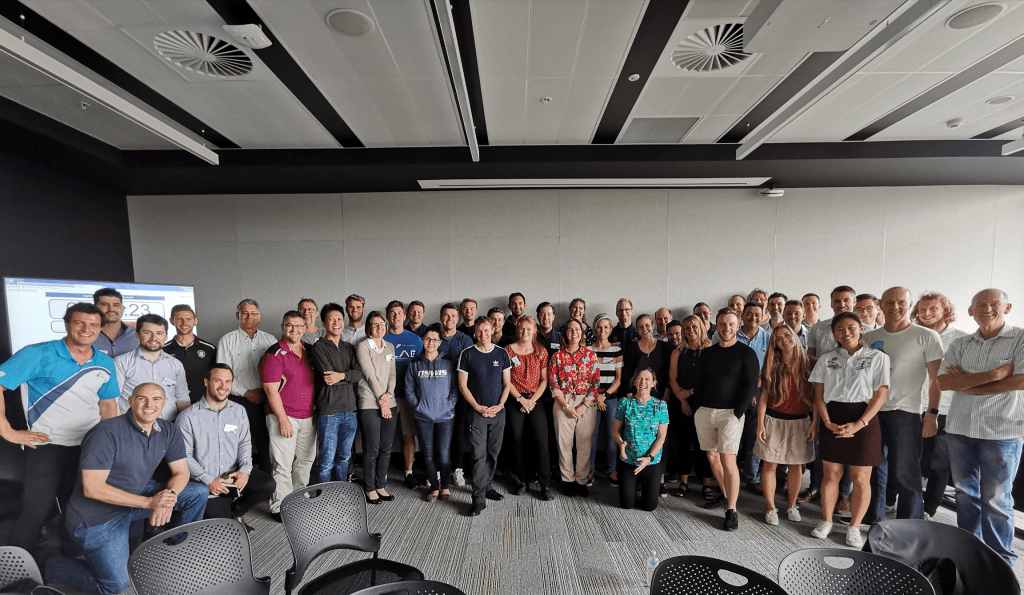
I’ll often joke that I mainly go to these events to see the people I love, but we know there’s truth in every joke. The need to be alongside others who want to take a forensic view at the things we spend our time doing, documenting the weird and wonderful things we find along the way, and then questioning if there’s another way we could/should/would be doing this is visceral for me. I mean, how many people describe a conference in those words!? but ultimately, that’s what they are about – at least, the good ones. It’s easy to forget that Australia is such a big place and we can go years not speaking face to face despite living in the same country. As I was writing this edition, I scrolled back through my newsletters knowing I had written about ‘a room full of people I love‘, and again, this was about a conference haha!
Several years later, I land in Singapore in late November for the 2025 Edition. I am now 3 years post-PhD and have even more to talk about, but the direction and depth has shifted. Talent development is still at the core of my curiosity, and now you’ll hear it humming along inside a tangled mess of ecological dynamics and nonlinear pedagogy, an obsession with the social sciences and the diversity of qualitative research, creativity and art as research methods, even a bit of post-humanism, pondering the universe in new/different ways, and the tension of working in high-performance sport. You’d be forgiven if you were expecting the wide-eyed and nervous student that wandered through the halls in 2018 and couldn’t find them anywhere, because this boisterous, tattooed nerd signed in with the same name. Some things don’t change because ultimately, despite having 12 minutes to talk, I only really presented one slide… but this time it was hand drawn.
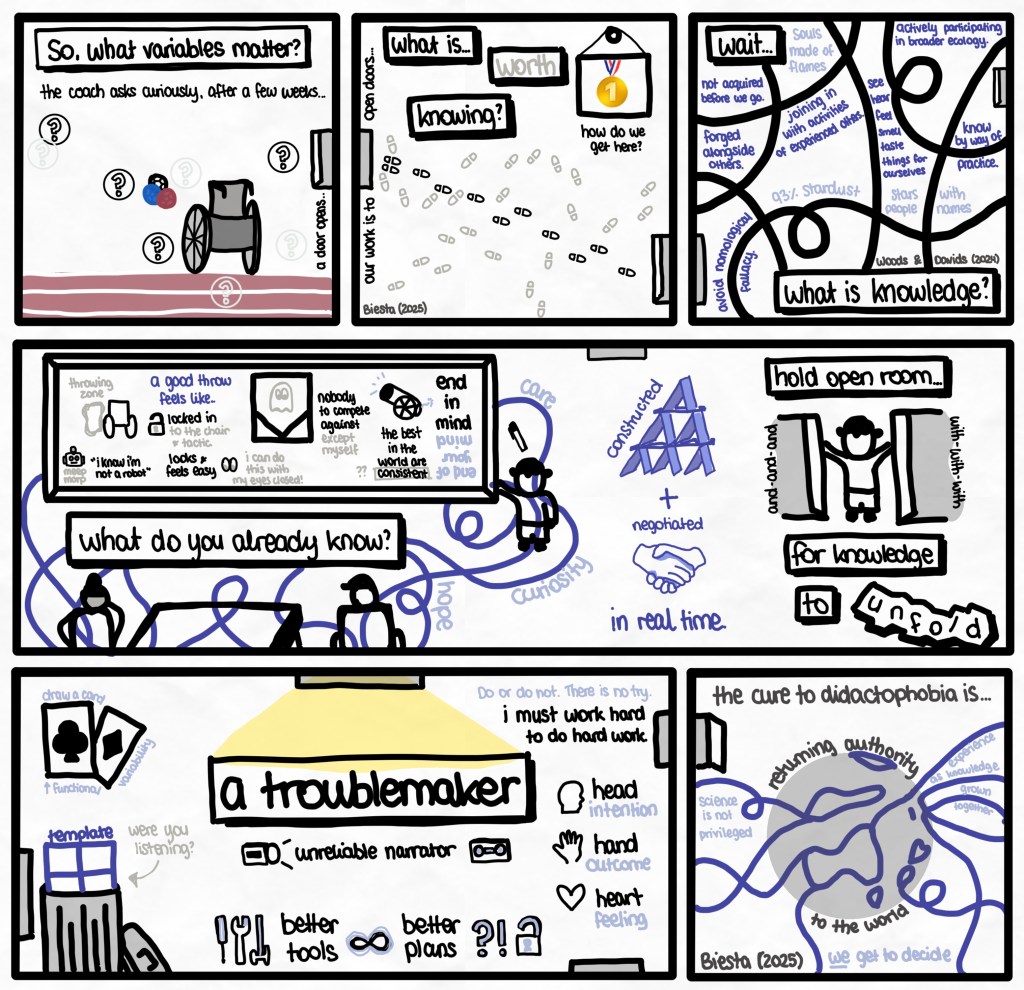
Yep, I feel so safe in this environment, and honestly just in who I am as a scholar and thinker and scientist, that I presented a comic. Hand-drawn, hours of scribbling on my iPad mini, documenting the tumultuous experience of a sport scientist in-becoming – me! My first role within the revered institute network, working with incredibly ambitious and capable human beings dreaming of performing at the highest level of their game internationally, it’s a whole new world. Damn, I should have made this Aladdin themed!
Like many of the things I wonder and write about, my first question is usually… who am I to be the one to talk about this? is this even important enough to tell other people about? I’m getting better at having those thoughts and doing it anyway. The need to draw this particular unfolding experience as we went was partially because I wanted to document the many different ways that ‘impact’ can manifest in our line of work for skill acquisition and coach development. But then it became something more, a storied account of our shared experiences, something we could reflect on and choose our next direction with. So many threads would come up in each training session, burning questions that capture our whole attention in one moment and are gone the next, until they subtly reappear a few weeks down the line. Being able to trace these threads, to notice when they rear their head, when they get under our skin some days and are easily brushed off on other days, helps us keep the brilliant, messy, human elements of learning together.
But there’s something deeper here, and it comes back to the question I posed in an earlier post: do we really need this? If you take a deeper look at the comic, you’ll notice the storyline about knowledge. This talk was really about epistemology, how we define what is knowledge. So stop and think about that question now for a moment, what is knowledge and how do we come to know something?
I was told recently that this question isn’t really necessary, that it’s too deep, that we need not worry ourselves with such things… but this question is at the core of everything we do, whether we consciously know it or not. I had considered my definition before, but only briefly while delving into qualitative research methods and researcher positionality, as if those were the only reasons to interrogate it. When the coach turned to me and asked what is worth knowing in their sport, I was absolutely floored by the gravity of that question. I was adamant that I am not the one to decide the answer but rather, we will find the answer out in the world we were both directly experiencing – standing in the lab together, thinking feeling moving speaking through different versions of a training session that unfold every Wednesday morning.
Okay so you’re probably reading this and wondering, does everyone speak/think like this?! Do you go to these conferences to have conversations about this kinda stuff!? And sometimes the answer is yes, but more commonly the answer is no – which brings us to the title of this edition. Like many conference experiences, the best conversations happen while sitting at the social events after a full day of content, nursing a drink and pondering aloud the things we rarely get to unpack alone in our own environments. I’d rhymed my talk to be subtitled “the practicality of epistemology” and the intrigue hit my colleagues and friends the night before my presentation. As we sat atop a hill, in a gorgeous little courtyard in the pouring rain, sweating from every pore in the humid Singapore evening, we tried to have a conversation about ontology and epistemology.
As we fumbled through it, I couldn’t help but stop and smile at the people crowded around this little table. Some could name different ontological positions and would work through why one fit for them more than the other, while I used everyday things like my tattoos and favourite poems to illustrate how I think about the world, and then we would map the spaces between those positions to see where different beliefs fit into it all. To me, that is what true scholarship is, guided by experienced others not just because they have spent more time in academia or have conviction, but because we are willing to venture through these mind-boggling conversations together, unbothered by the uncertainty of it. I simultaneously thrive and struggle in these settings, because I have often had an answer to the questions posed of me and still find it painful to say I don’t know (yet). But moments like these, with brilliant people, make it infinitely easier to occupy that unknown space a little longer, like an oxygen tank for a space walk.
When I finished my presentation at ASAN, we went straight into a tea break and there was an audible sigh of relief. A few people came up to me and said “thank goodness I didn’t have to present immediately after you!” hahaha what a lovely compliment. But my favourite comment echoed the sentiment of the night before, that what I am thinking drawing writing about is different, in a good way.
“We are here playing checkers, and you’re playing 4-D chess!”
Join me on the chessboard if you dare. Ask the questions that leave you a little lost in the pursuit of answers, ponder the things we take for granted in everyday interactions, and most importantly, talk to your damn friends and authors you adore about the things that capture your curiosity. Who knows where it might take you.
 butterfly affect
Leave a comment